
You're working harder than ever. Your calendar is packed with client projects, your inbox is overflowing with requests, and you're putting in 50+ hour weeks. Yet somehow, at the end of the month, you're barely scraping by. You're exhausted, stressed, and wondering why success doesn't feel more... successful.
If this sounds familiar, you might be experiencing one of the most common—and most damaging—mistakes freelancers make: undercharging for your work.
Here's the hard truth: 83% of freelancers charge less than market rates. You're not alone in this struggle. Whether it's imposter syndrome, fear of losing clients, or simply not knowing what to charge, undercharging is a silent income killer that affects your business, your health, and your future.
The good news? Recognizing that you're undercharging is the first step toward fixing it. And raising your rates is far easier than you think—most freelancers who increase their prices thoughtfully don't lose clients. They lose the wrong clients and gain better ones.
In this article, we'll walk through 10 clear warning signs that you're undercharging, plus exactly what to do about each one. By the end, you'll know whether your rates need a minor adjustment or a complete overhaul. And we'll give you a concrete action plan to implement changes without the fear and guilt that often holds freelancers back.
Let's start by assessing where you stand. Use our rate calculator to find your market-appropriate rate—it takes just a few minutes and will give you a baseline to compare against the signs below.
Quick Self-Assessment: Do These Signs Apply to You?
Check all that apply to your current situation:
Scoring Guide:
✓ 1-3 signs: Minor adjustments needed. You're close to market rates but could optimize.
✓ 4-6 signs: Significant rate increase needed. Your rates are holding you back.
✓ 7-10 signs: Urgent pricing overhaul required. Your current rates are unsustainable.

You're Constantly Busy But Barely Making Ends Meet
This is the most common sign of undercharging, and it's the most painful. You're working constantly—your calendar is full, you're responding to client emails at night, and you rarely have a free weekend. Yet when you look at your bank account, you're struggling to cover rent, groceries, and basic expenses.
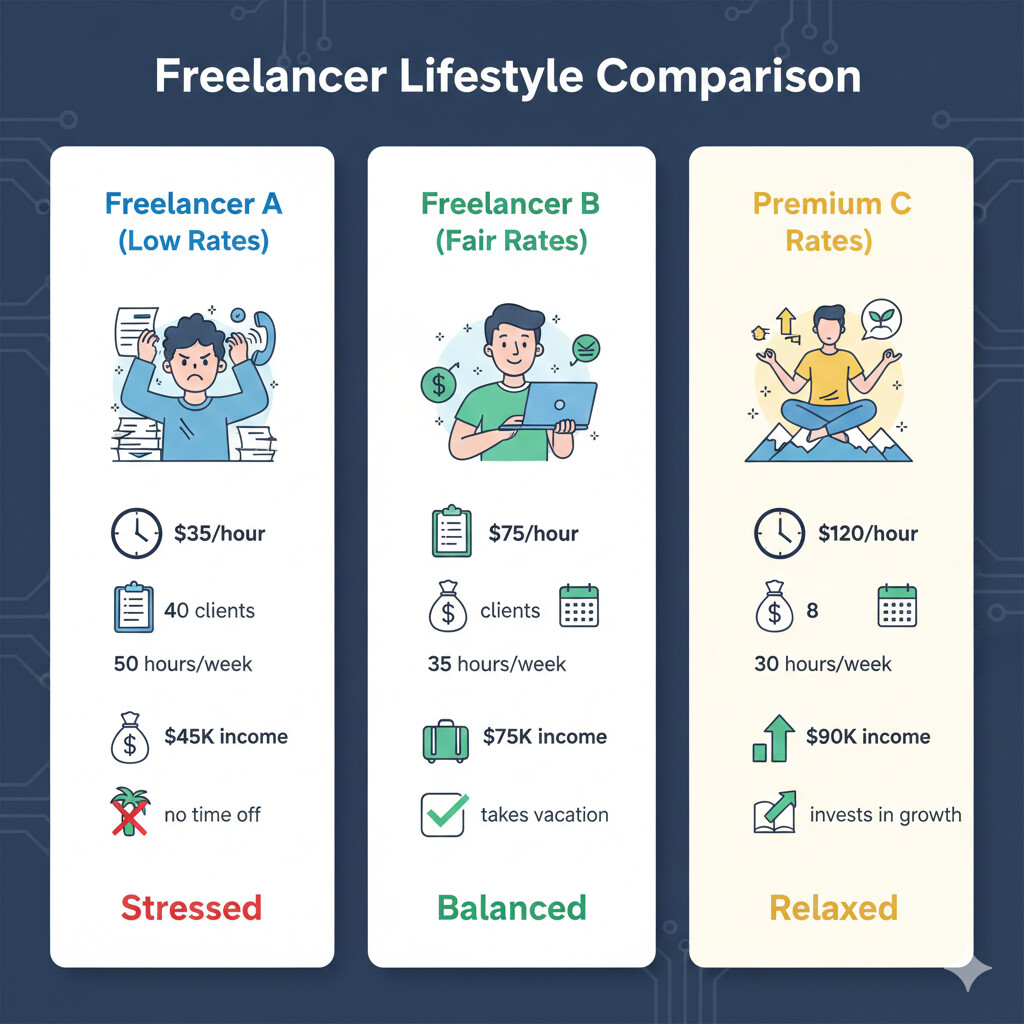
Here's what's happening: you're trading time for money at a rate that doesn't work. If you're working 40+ hours per week but earning less than $40,000 annually, your hourly rate is the problem. The math is simple but brutal: more hours at low rates doesn't equal financial stability.
What to Do About It
Calculate your actual hourly rate. Take your annual income and divide it by the number of hours you actually work (not billable hours—total hours). Be honest about this number. If it's below $25/hour, you're undercharging.
Compare to your minimum viable rate. What do you need to earn annually to cover expenses and have a comfortable life? Divide that by your billable hours (typically 50-70% of total work time). That's your floor.
Identify which clients to raise rates for. You don't have to raise rates for everyone at once. Start with new clients at your new rate, and gradually increase rates for existing clients.
Calculate what you should actually be charging with our rate calculator—it factors in your desired income, expenses, and billable hours to show you exactly what you need to earn.
Clients Always Say "Yes" Without Negotiating
When you send a proposal with your rates, do clients ever push back? Do they ever ask for a discount or try to negotiate? If the answer is "almost never," that's a red flag that you're priced too low.
Here's the psychology: if your rate is fair and market-appropriate, some clients will negotiate. It's normal. Industry standard suggests that 20-30% of proposals should face some negotiation or pushback. If 100% of your clients accept your rates immediately without question, you're leaving thousands of dollars on the table.
Clients who accept immediately are essentially telling you: "I would have paid more." They're not complaining because they're getting a great deal. And they're not going to volunteer to pay you more—that's your job.
What to Do About It
Test higher rates with new clients. Increase your rate by 15-25% for your next 5-10 proposals. Track how many clients accept without negotiation.
Track your acceptance rate. Keep a simple spreadsheet: proposal sent, rate quoted, client response. This data is gold for understanding your market position.
Gradually increase until you find resistance. You want to find the sweet spot where some clients negotiate but most still accept. That's your market rate.
You Haven't Raised Your Rates in Over a Year
When was the last time you increased your rates? If you can't remember, or if it's been more than 12 months, you're definitely undercharging.
Industry standard is an annual rate increase of 5-15%. This isn't greedy—it's necessary. Your costs go up every year (inflation, software subscriptions, health insurance). Your skills improve every year. Your experience becomes more valuable every year. Yet if you keep your rates static, you're effectively taking a pay cut.
Think about traditional employment: most jobs include annual raises. Freelancing should be no different. In fact, you should be more aggressive about raises because you don't have the safety net of employer benefits or job security.
What to Do About It
Set an annual rate review date. Mark it on your calendar right now—maybe January 1st or your business anniversary. Make it a non-negotiable annual ritual.
Calculate your inflation-adjusted rate. At minimum, increase your rate by the inflation rate (currently 2-3% annually). But aim for 5-10% to account for skill growth and market increases.
Implement immediately for new clients. Your new rate applies to all new projects starting today. Existing clients can stay at their current rate until their contract renews (or you can grandfather them for 6 months, then increase).
Use our calculator to find your inflation-adjusted rate and see what your new pricing should be based on current market conditions.

You're Making Less Per Hour Than Your Target Salary
Let's do some math. If you want to earn $60,000 annually, and you work 40 billable hours per week for 50 weeks per year, you need to charge at least $30/hour. But here's the catch: only 50-70% of your work time is billable. The rest goes to admin, marketing, proposals, and other non-billable tasks.
So if you actually work 40 hours per week but only bill for 25 hours, you need to charge $48/hour to hit that $60,000 target. Many freelancers don't account for this gap, which is why they feel like they're working constantly but not earning enough.
What to Do About It
Calculate your true hourly rate from your annual goal. Start with your desired annual income. Subtract taxes (25-30%), business expenses, and time off. Divide by your billable hours. That's your minimum rate.
Factor in taxes, expenses, and time off. As a freelancer, you pay both sides of payroll taxes (15.3% in the US). You also need to cover health insurance, software, equipment, and other business costs. Don't forget vacation days and sick days—you need to earn enough to cover those too.
Adjust your rates to meet your income target. If the math shows you need to charge $75/hour but you're currently charging $45/hour, that's your gap. You need to close it.
Our rate calculator does all this math for you—just input your desired income, expenses, and billable hours, and it shows you exactly what to charge.
Clients Treat Your Time Casually or Request Excessive Revisions
Do clients frequently ask for "quick changes" that turn into hours of work? Do they request unlimited revisions? Do they expect you to be available at all hours? Do they treat your time as if it's free?
There's a direct correlation between low rates and demanding client behavior. When you charge very little, clients perceive your work as having low value. They don't respect your time because they haven't invested much in you. It's not personal—it's psychology. People value what they pay for.
The clients who push back hardest on pricing are often the ones who will be the most demanding and least appreciative. Conversely, clients who pay premium rates tend to be more respectful, more decisive, and easier to work with.
What to Do About It
Understand that higher rates attract better clients. This isn't just about money—it's about client quality. When you raise your rates, you naturally filter out the most demanding, least appreciative clients. The ones who remain are more professional and respectful.
Set clear boundaries and revision limits. Include revision limits in your contracts (e.g., "2 rounds of revisions included; additional revisions $X each"). Charge for scope creep. Be firm about deadlines and availability.
Fire problem clients and raise rates for new ones. If a client is consistently disrespectful of your time, it's okay to end the relationship. Use that freed-up time to take on higher-paying clients.
Client behavior red flags: Requests for "quick favors," scope creep without additional payment, expecting 24/7 availability, frequent revision requests, last-minute deadline changes, or treating your work as a side project rather than a professional service.
You Can't Afford Your Own Business Expenses Comfortably
Running a freelance business requires investment. You need software subscriptions, professional tools, maybe a website, accounting software, project management tools, and continuous learning. If you're struggling to afford these essentials, your rates are too low.
When you're operating on razor-thin margins, you can't invest in the tools and education that would make you more efficient and valuable. This creates a vicious cycle: you can't afford better tools, so you work slower, so you need to take on more clients, so you have less time to improve your skills.
What to Do About It
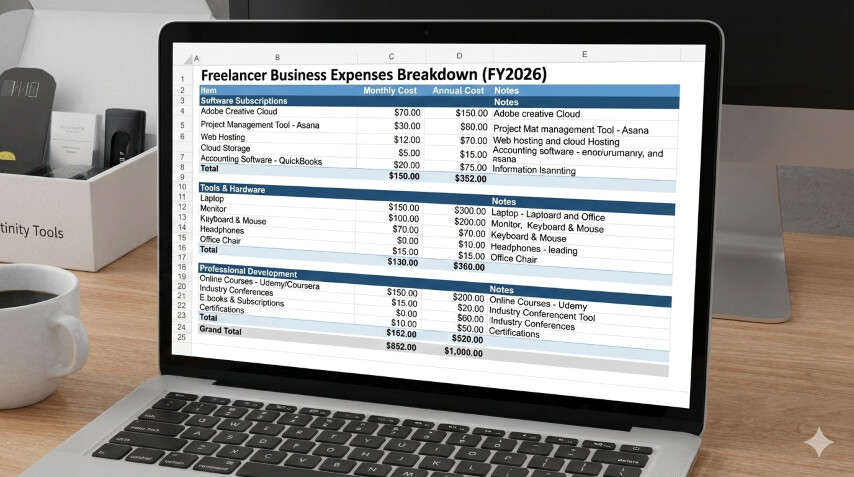
List all your business expenses (annual cost). Software subscriptions, hardware, professional development, insurance, accounting, marketing, website hosting, etc. Add them up.
Ensure your rates cover these PLUS your desired income. Your rates need to generate enough revenue to cover all business expenses and still leave you with your target personal income.
Business expense checklist: Accounting software, project management tools, design/development software, website hosting, domain registration, professional liability insurance, health insurance, continuing education, marketing and networking, equipment and hardware, phone/internet, office space (if applicable).
Our calculator includes business expenses in its calculation, so you can see exactly how much you need to charge to cover everything.
You're Charging What You Charged When You Started (Despite More Experience)
When you first started freelancing, you might have charged $25/hour because you were building your portfolio and gaining experience. That made sense then. But if you're still charging $25/hour after 3, 5, or 10 years of experience, you're leaving massive money on the table.
Your experience is your most valuable asset. You work faster. You deliver better quality. You solve problems more efficiently. You understand client needs better. You've made mistakes and learned from them. All of this makes you more valuable, and valuable work commands higher rates.
Consider any other profession: a doctor doesn't charge the same rate after 20 years of experience as they did on day one. A lawyer doesn't either. Why should you?
What to Do About It
Audit your skill growth since starting. What can you do now that you couldn't do when you started? What problems can you solve faster? What results do you deliver better? Document this.
Research current market rates for your experience level. Look at job postings, freelance platforms, and industry surveys. What are experienced freelancers in your field charging?
Create tiered pricing based on experience. You might offer different rates for different project types or client sizes. Premium rates for complex projects, retainer rates for ongoing work, etc.
Implement an immediate increase for experience gained. If you've been at your current rate for 2+ years, increase by at least 20-30%. You've earned it.
| Experience Level | Typical Hourly Rate Range | Annual Income (40 billable hrs/week) |
|---|---|---|
| Beginner (0-2 years) | $25-40/hour | $52,000-83,000 |
| Intermediate (2-5 years) | $50-75/hour | $104,000-156,000 |
| Advanced (5+ years) | $85-150+/hour | $176,000-312,000+ |
Note: These ranges vary significantly by industry, location, and specialization. Use them as a reference point, not gospel.
You're Significantly Below Market Rates for Your Industry/Location
Market rates vary dramatically by industry, location, and specialization. A freelance writer in rural areas might charge $0.10/word, while a specialized technical writer in a major city might charge $0.50/word. A junior web developer might charge $40/hour, while a senior developer with specialized skills might charge $150+/hour.
If you're 20%+ below the average rate for your industry and experience level, you're undercharging. This is one of the easiest signs to verify—you just need to do the research.
What to Do About It
Research industry salary surveys. Check out reports from Freelancers Union, Upwork, and industry-specific organizations. These often publish rate data.
Check freelance platform rate data. Platforms like Upwork, Fiverr, and Toptal show what freelancers are charging. Filter by your experience level and location.
Join professional communities to compare. Facebook groups, Slack communities, and professional associations often discuss rates. Ask peers what they charge (many are happy to share).
Adjust to market rates (or above for specialization). If market rate is $75/hour and you're charging $45/hour, you have a $30/hour gap to close. If you have specialized skills or a strong portfolio, you can charge above market rate.
Use our calculator to see what your rate should be based on your goals and expenses, then compare it to market data to ensure you're in the right ballpark.
You Feel Resentful or Burned Out By Your Work
This is the emotional sign of undercharging, and it's just as important as the financial signs. Do you feel resentful toward your clients? Do you dread opening your email? Do you feel taken advantage of? Do you have money anxiety despite working hard?
These feelings are often attributed to "difficult clients" or "too much work," but the real culprit is usually undercharging. When you're not earning what you deserve, resentment builds. When you're working 50+ hours for $40,000/year, burnout is inevitable.
The good news: this is fixable. And the fix isn't working harder or finding better clients—it's charging more.
What to Do About It
Recognize this as a rate problem, not a client problem. Before you fire all your clients or quit freelancing, try raising your rates. You might be surprised how much better you feel.
Calculate rates that would eliminate resentment. What would you need to earn to feel good about your work? What hourly rate would make you feel valued? Work backward from that number.
Commit to raising rates for mental health. This isn't just about money—it's about your wellbeing. You deserve to feel good about your work.
Plan transition to sustainable pricing. You don't have to raise rates overnight. But commit to a timeline: new clients at new rates immediately, existing clients transitioned over 6-12 months.

You Can't Afford to Take Time Off or Get Sick Without Financial Stress
This is the ultimate sign of undercharging: financial fragility. If you can't take a week off without panicking about money, you're not charging enough. If you can't afford to be sick for a few days, you're not charging enough. If you're living paycheck to paycheck despite working full-time, you're not charging enough.
Freelancing should provide financial stability, not constant anxiety. You should be able to take vacation, handle emergencies, and build savings. If you can't, your rates are the problem.
What to Do About It
Calculate rate that includes paid time off. If you want 4 weeks of paid time off annually, you need to earn enough in 48 weeks to cover 52 weeks of expenses. This means your hourly rate needs to be about 8% higher than if you worked year-round.
Build 6-12 month emergency fund into pricing. You should have 6-12 months of expenses saved. Your rates need to generate enough income to build this fund while also covering current expenses.
Account for sick days and vacation in annual goals. Don't assume you'll work 52 weeks per year. Plan for 48-50 weeks of billable work, and price accordingly.
Financial stability checklist: Can you take 2+ weeks of vacation without financial stress? Can you handle a $5,000 emergency? Do you have 3+ months of expenses saved? Can you afford health insurance? Can you contribute to retirement? If you answered "no" to any of these, your rates are too low.
Our calculator factors in time off and helps you calculate a rate that provides financial stability.

How to Actually Raise Your Rates (Without Losing Clients)
You've identified that you're undercharging. Now comes the scary part: actually raising your rates. This is where fear takes over. "What if I lose all my clients?" "What if they think I'm greedy?" "What if no one hires me at the new rate?"
Let's address this directly: most freelancers don't lose clients when raising rates thoughtfully. In fact, research shows that freelancers who raise rates by 25-50% typically lose less than 15% of clients but increase income by 30-40%. The math works out in your favor.
Step 1: Calculate Your New Rate
Use our rate calculator to determine your target rate. Don't guess. Use data: your desired income, business expenses, billable hours, and market rates. This gives you confidence in your new number.
Step 2: Decide on Your Implementation Strategy
You have two main options:
Option A: Grandfather existing clients, new rate for new clients. This is the gentler approach. Your current clients keep their current rate (for now), but all new clients are quoted at your new rate. After 6-12 months, you can transition existing clients to the new rate.
Option B: Raise rates for everyone with notice. Send existing clients a professional email 30-60 days in advance, explaining the rate increase and when it takes effect. Most will accept. Some might push back, but that's okay.
We recommend Option A if you have strong client relationships and want to minimize friction. Option B if you want to move faster and are confident in your value.
Step 3: Implement Immediately for New Clients
Starting today, all new proposals should be at your new rate. Don't wait. Don't ease into it. Your new rate is your rate.
Step 4: Announce to Existing Clients (If Raising for Everyone)
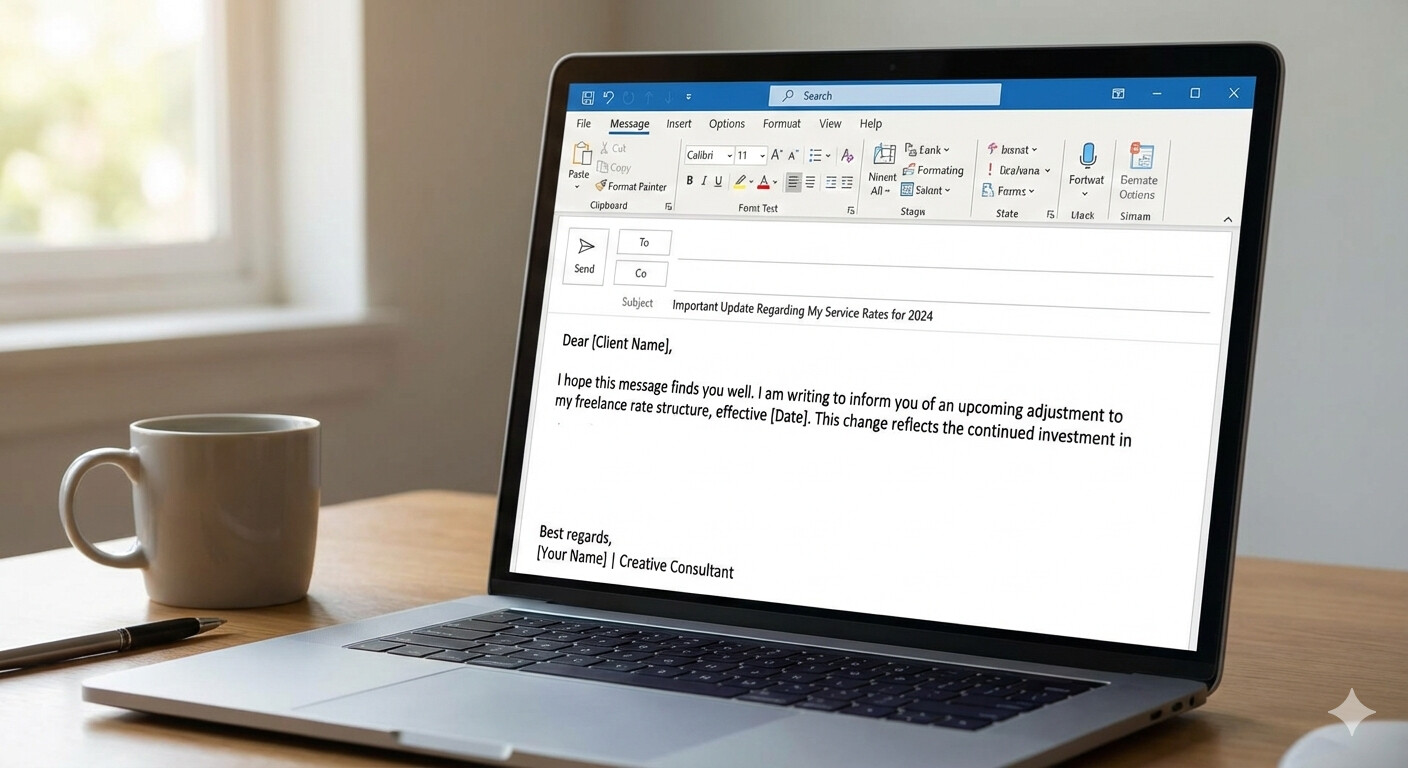
If you're raising rates for existing clients, send a professional email 30-60 days before the increase takes effect. Here's a template:
Subject: Important Update About My Rates (Effective [Date])
Hi [Client Name],
I wanted to give you advance notice that my rates will be increasing to [new rate] effective [date]. This increase reflects my expanded experience, the value I deliver, and current market rates for my services.
Your current projects will continue at your current rate through [date]. Any new projects starting [date] will be at the new rate.
I've valued working with you and hope to continue our partnership. Please let me know if you have any questions.
Best regards,
[Your Name]
Step 5: Provide Reasoning
Clients are more likely to accept rate increases when they understand why. Mention:
- Your expanded experience and skills
- Increased business expenses (inflation, new tools, etc.)
- Market rate alignment
- Increased value you deliver
Step 6: Offer Transition Options
For clients who push back, you might offer:
- A phased increase (10% now, 10% in 6 months)
- A retainer discount if they commit to ongoing work
- A package deal for multiple projects
But don't discount too much. You're not negotiating your value down—you're offering options for how they want to work with you.
Step 7: What to Do If Clients Push Back
Some clients will push back. That's normal. Here's how to handle it:
Listen to their concern. They might have budget constraints, or they might not understand your value. Ask questions.
Reiterate your value. Remind them of the results you've delivered, the problems you've solved, and the value you provide. Don't apologize for your rates.
Stand firm. You've done the research. You know your market rate. Don't undercut yourself just to keep a client.
Know when to walk away. If a client won't pay fair rates, it's okay to end the relationship. You'll replace them with better clients at better rates.
The Confidence Factor
The most important factor in successfully raising rates is confidence. You need to believe you're worth the new rate. If you don't, clients will sense it and push back.
Build confidence by:
- Documenting your results and impact
- Collecting testimonials from satisfied clients
- Researching market rates and seeing you're below average
- Calculating the math and seeing you need the increase
- Remembering that you're not being greedy—you're being fair
You've earned this rate increase. Own it.
Common Objections and How to Overcome Them
As you prepare to raise your rates, you'll likely encounter objections—from clients, from yourself, from your inner critic. Let's address the most common ones:
Reality: You might lose 10-20% of your clients—specifically, the ones who were only hiring you because you were cheap. The better clients will stay. And you'll replace the lost clients with higher-paying ones. Net result: more income, fewer clients, less stress.
This is imposter syndrome talking, not reality. If you're delivering results, you deserve fair pay. Experience is relative to your market. A freelancer with 3 years of experience in a small market might be more experienced than someone with 5 years in a competitive market. Charge based on your value, not your self-doubt.
Competing on price is a losing strategy. You'll never be the cheapest, and even if you are, you'll be miserable. Instead, compete on specialization, quality, and results. Find a niche where you can be the best, not the cheapest. Charge premium rates for premium work.
It's business, not personal. Clients understand that rates increase. They expect it. Practice your pitch until you're comfortable. Write it down. Say it out loud. The more you practice, the more confident you'll be. And remember: if a client gets upset about a reasonable rate increase, they're not a good client anyway.
You're probably not. Most freelancers underestimate their value. And even if you're slightly high, you can always adjust. But start by raising to market rate. If clients push back, you can lower slightly. But don't start low and hope to raise later—it's much harder.
At some point, your portfolio is good enough. You don't need 100 projects to charge fair rates. If you've been freelancing for 2+ years and have a solid portfolio, you're ready. Stop waiting for the perfect moment. The perfect moment is now.
Real Examples: Freelancers Who Raised Their Rates
Sarah, Freelance Writer
The Problem: Sarah was charging $0.08/word, earning about $40,000/year working 50 hours per week. She recognized signs #1, #4, #7, and #9—constantly busy but barely making ends meet, making less than her target salary, charging what she started with, and feeling resentful.
The Action: She calculated her target rate ($0.18/word based on desired income and billable hours) and implemented it for new clients immediately. She grandfathered existing clients for 6 months, then transitioned them to the new rate.
The Result: She lost 2 of her 12 clients (the most demanding ones). Her income increased to $62,000/year, and she now works 35 hours per week. She feels valued, less stressed, and actually enjoys her work again.
Marcus, Web Developer
The Problem: Marcus had been charging $50/hour for 6 years—the same rate he started with. He recognized signs #2, #5, and #8—clients always said yes without negotiating, clients treated his time casually, and he was significantly below market rates ($85-120/hour for his experience level).
The Action: He raised his rate to $95/hour for new clients and sent existing clients a professional rate increase notice with 60 days notice. He emphasized his experience, the value he delivers, and market alignment.
The Result: He lost 1 client who couldn't afford the increase. But he gained higher-quality projects, fewer demanding clients, and increased his income by 60%. His stress level dropped significantly.
Chen, Graphic Designer
The Problem: Chen was charging $35/hour and hadn't raised rates in 3 years. She recognized signs #3, #6, and #10—hadn't raised rates in over a year, couldn't afford business expenses comfortably, and couldn't afford to take time off without financial stress.
The Action: She calculated her target rate ($65/hour based on desired income, expenses, and time off) and implemented it for new clients. She gave existing clients 30 days notice of a $50/hour rate for new projects.
The Result: She lost 3 of her 15 clients. But her income increased by 45%, she could finally afford health insurance, she started contributing to retirement, and she could take a week off without panicking. She's much happier.
Your Action Plan: Steps to Take Today
Don't just read this article and move on. Take action. Here are the specific steps to implement rate increases:
- Complete the self-assessment checklist above and count how many signs apply to you
- Calculate your actual current hourly rate (annual income ÷ total hours worked)
- Use our rate calculator to find your target rate
- Research market rates in your industry and location (check Upwork, Freelancers Union, industry surveys)
- Identify which clients to raise rates for first (new clients immediately, existing clients gradually)
- Set a specific date for implementing new rates (e.g., "All new clients starting March 1st")
- Draft your client communication about rate increases (use the template provided above)
- Commit to annual rate reviews (mark it on your calendar right now)
- Track your acceptance rate on new proposals to see if you need to adjust further
- Celebrate when you land your first client at the new rate—you've earned it
The Bottom Line: You Deserve Fair Compensation
Undercharging is one of the most common and most damaging mistakes freelancers make. And it's completely understandable why: fear, imposter syndrome, inexperience, and the pressure to compete on price all push us toward lower rates.
But here's the truth: 83% of freelancers charge less than market rates. If you're reading this and recognizing yourself in these signs, you're not alone. This is an extremely common problem. And it's fixable.
Raising your rates isn't greedy. It's not arrogant. It's not taking advantage of clients. It's necessary. It's sustainable. It's the difference between a freelance career that drains you and one that fulfills you.
Think about the ripple effect: better rates → better clients → better work → better life. When you charge what you're worth, you attract clients who value your work. You have time to do your best work. You feel good about what you do. You can afford to take time off. You can invest in your skills. You can build a sustainable business.
The alternative—continuing to undercharge—leads to burnout, resentment, and financial stress. It's not sustainable. And it's not necessary.
So here's my challenge to you: identify which of the 10 signs apply to you. Calculate what you should actually be charging. Use our calculator to find your market-appropriate rate. And commit to raising your rates—either immediately for new clients, or with a timeline for existing clients.
You've worked hard to develop your skills. You deliver value to your clients. You deserve to be compensated fairly for that work. Not someday. Not when you have more experience. Now.
Your future self will thank you.
Frequently Asked Questions About Undercharging and Rate Increases
How do I know if I'm undercharging as a freelancer?
The clearest signs are: (1) you're working 40+ hours per week but barely making ends meet, (2) clients always accept your rates without negotiation, (3) you haven't raised rates in over a year, (4) you're making less per hour than your target salary, and (5) you feel resentful or burned out. Use the self-assessment checklist in this article to evaluate your situation. If 4+ signs apply to you, you're likely undercharging.
What percentage should I raise my freelance rates?
Industry standard is 5-15% annually for cost-of-living adjustments. However, if you're significantly below market rates, you might need a larger increase (20-50%) to reach fair pricing. Start by calculating what you should be charging based on your desired income, expenses, and billable hours. Then compare to market rates. The gap between your current rate and your target rate is your increase.
Will I lose clients if I raise my rates?
You might lose some clients—typically 10-20% of the least profitable ones. But research shows that freelancers who raise rates thoughtfully don't lose overall income. In fact, they usually increase income by 30-40% even with fewer clients. The clients you lose are often the most demanding and least appreciative. The clients who stay are more professional and easier to work with.
How often should freelancers increase their rates?
At minimum, annually. Mark a date on your calendar (e.g., January 1st or your business anniversary) for an annual rate review. Increase by at least the inflation rate (2-3%), but aim for 5-10% to account for skill growth and market increases. If you're significantly below market rates, you might increase more frequently (every 6 months) until you reach fair pricing.
What's the best way to tell clients about a rate increase?
Send a professional email 30-60 days before the increase takes effect. Explain the reason (experience, expenses, market alignment), specify the new rate and effective date, and offer options (grandfather existing clients, phased increase, retainer discount). Keep it brief and professional. Don't apologize for the increase—you've earned it. Most clients will accept without issue.
Is it normal to feel guilty about raising rates?
Absolutely. Most freelancers feel guilty about raising rates, even when they're significantly below market. This guilt is often rooted in imposter syndrome or fear of losing clients. But remember: you're not being greedy, you're being fair. Your clients understand that rates increase. They expect it. And if a client gets upset about a reasonable rate increase, they're not a good client anyway. The guilt usually fades once you land your first client at the new rate.
How much should I charge compared to market rates?
At minimum, you should charge at or above market rates for your experience level and location. If you have specialized skills, a strong portfolio, or a niche expertise, you can charge above market rates. Use industry surveys, freelance platforms, and professional communities to research market rates. Then calculate what you need to earn based on your desired income and expenses. Your rate should meet both criteria: fair market rate AND sufficient for your financial goals.
Explore More Freelance Pricing Guides
Check out our other articles on freelance pricing, rate calculations, and business strategies to help you succeed as a freelancer.
View All Articles